Weekly Advisory

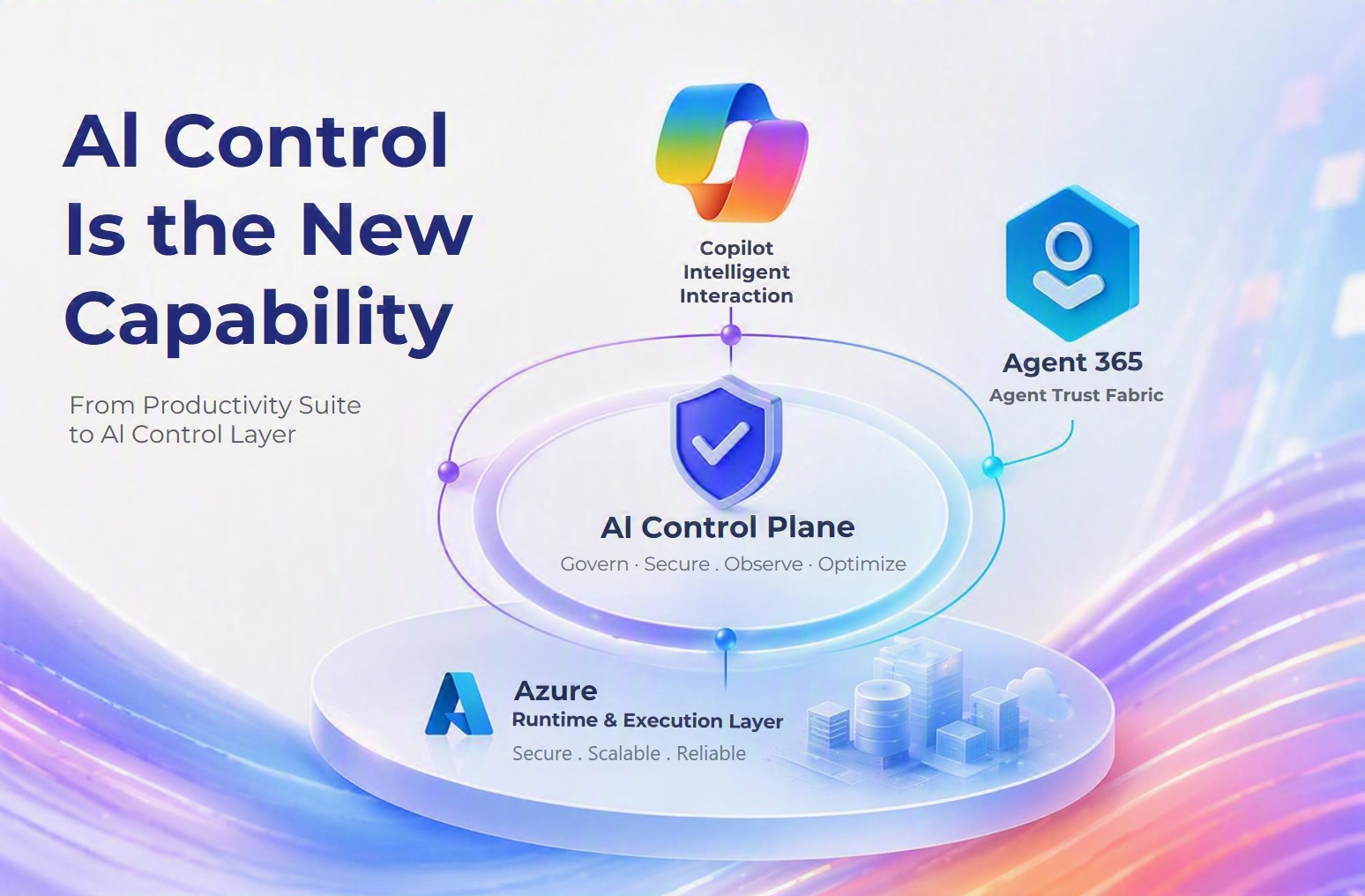
Microsoft 365 + Azure Are Converging Into an AI Platform

Three signals in June 2026 — M365 pricing restructuring, Azure's shift to an AI execution layer, and agents entering production — point to single convergence: Microsoft is becoming a unified AI platform. The technology is ready. For most organizations, governance, cost visibility, and security posture are not.

June 24, 2026 Seepath Solutions

This Week's Advisory

June 24, 2026

What's Actually Changing Across the Microsoft Platform

Three signals in June 2026 define where the Microsoft platform is headin…

What This Means for Enterprise Operations

The shift from productivity software to AI platform creates three operat…

Three Gaps Most Organizations Haven't Closed

Across the enterprises we work with, three operational gaps consistently…

Seepath Perspective

The most consequential mistake in enterprise AI right now is treating ad…

Microsoft 365 + Azure Are Converging Into an AI Platform — Costs, Security, and Control Are Now the Real Challenge

What's Actually Changing Across the Microsoft Platform

Three signals in June 2026 define where the Microsoft platform is heading — and why the implications extend well beyond a pricing adjustment.

Signal 1
M365 Pricing Restructuring

Effective July 1, 2026

Microsoft 365 prices rise 5–33% on July 1 — but the bigger shift is structural. Security tools and Copilot AI are now bundled into standard plans. M365 is becoming an AI and security platform, not just a productivity suite.

Signal 2
Azure Becomes the AI Execution Layer

Microsoft Build 2026

Microsoft Build 2026 shifted Azure from cloud infrastructure to the operating layer for enterprise AI. Organizations can now deploy autonomous AI agents with built-in compliance controls — at enterprise scale.

Signal 3
AI Agents Enter Production

June 2026

With AI agents move into production, the cost shifts from fixed seats to consumption-based, meaning costs scale with how much AI your organization actually runs.

The July 1 pricing update reflects this repositioning directly. For the full context, see our M365 pricing advisory.

M365 Plan Current July 1 Change
Business Standard $12.50/user/mo $14.00/user/mo +12%
E3 $36.00/user/mo $38.00/user/mo +6%
E5 $57.00/user/mo $60.00/user/mo +5%

What This Means for Enterprise Operations

The shift from productivity software to AI platform creates three operational changes that most organizations are not yet managing explicitly.

Dimension Before Now Why It Matters
Cost model Fixed per-seat licensing — predictable, monthly Consumption-based AI metering layered on top of fixed seats Unmanaged agent and Copilot usage creates variable cost exposure above the fixed licensing increase
Visibility model Track license counts and user activity Track agent activity, data access patterns, and AI consumption IT teams need to know what agents are doing — not just what users are doing
Security model Policy defined in configuration files Agent runtime control — what agents access and act on, continuously Agent-specific behavioral monitoring is now a prerequisite, not optional hardening

For organizations that have already deployed Copilot or Azure AI workloads, our Azure cost advisory identified AI-driven compute and token consumption as the leading driver of unexpected cloud cost increases. That pattern accelerates as agent adoption scales.


Three Gaps Most Organizations Haven't Closed

Across the enterprises we work with, three operational gaps consistently emerge as AI adoption scales.

Cost becomes unpredictable AI workloads do not follow linear cost curves. Token consumption, agent execution cycles, and Azure AI inference can spike sharply based on workflow volume or misconfigured agent policies. The variable cost exposure from unmanaged AI consumption frequently exceeds the fixed licensing increase within the first quarter of active agent deployment. Our AI token economics advisory covers this pattern in detail.

You lose visibility across AI activity Most organizations can count their M365 licenses. Very few can identify how many AI agents are currently active across their tenant, what data those agents are accessing, or how much is being consumed across endpoints, cloud, and SaaS applications. Without this visibility, cost optimization is essentially impossible — governance decisions are made with incomplete information.

Security expands beyond traditional controls June's Patch Tuesday addressed approximately 200 vulnerabilities, including zero-days actively exploited in production environments. More structurally, agents operating continuously with broad data access represent a security risk category that traditional endpoint models were not designed to detect or contain. Runtime governance via Microsoft's Agent 365 control plane is now a baseline requirement.


Seepath Perspective

The most consequential mistake in enterprise AI right now is treating adoption as a technology decision. It is an operational, financial, and governance decision — one that happens to involve technology.

Microsoft has built the capability. Azure Agent Service, MAI models with compliance trust rubrics, Agent Trust Fabric, and consumption-based pricing are in production today. The question is not whether the platform is ready. It is whether the organizations deploying it have built the operational foundation to manage what they are deploying.

At Seepath, we focus on that foundation — for financial services, healthcare, and professional services organizations that need governance to keep pace with adoption:

  • Azure cost governance — visibility, alerting, and optimization for AI and cloud workloads before costs compound
  • Microsoft 365 licensing optimization — right-sizing SKUs and modeling AI readiness ahead of the July 1 pricing update
  • AI governance and agent control — deploying Agent Trust Fabric, Defender for Cloud, and Purview as an integrated governance layer
  • Identity and Zero Trust baseline — Entra, conditional access, and endpoint hardening for environments running AI agents

The organizations that get this right will not just control risk — they will operate faster, with better decisions and measurable cost efficiency.

The organizations that succeed will not be the ones that adopted AI fastest. They will be the ones that can control, secure, and operationalize it at scale.

If you don't know your AI consumption, agent activity, and data exposure today, you are already operating blind. Start with a structured AI governance and licensing assessment.

Request your AI Governance and Licensing Assessment →


Ready to Get Started?

Talk to a Seepath expert about your Azure, security, or AI strategy — no sales pressure.

Contact Us

Weekly Advisories

Get the latest Microsoft security, Azure, and AI updates delivered weekly.

Subscribe

Want Personalized Guidance?

Seepath has been a Microsoft Direct Bill CSP since 2014 — serving financial services and healthcare organizations.
with hands-on Azure, security, and AI implementation.

Free Azure Assessment Talk to an Expert