AI Governance

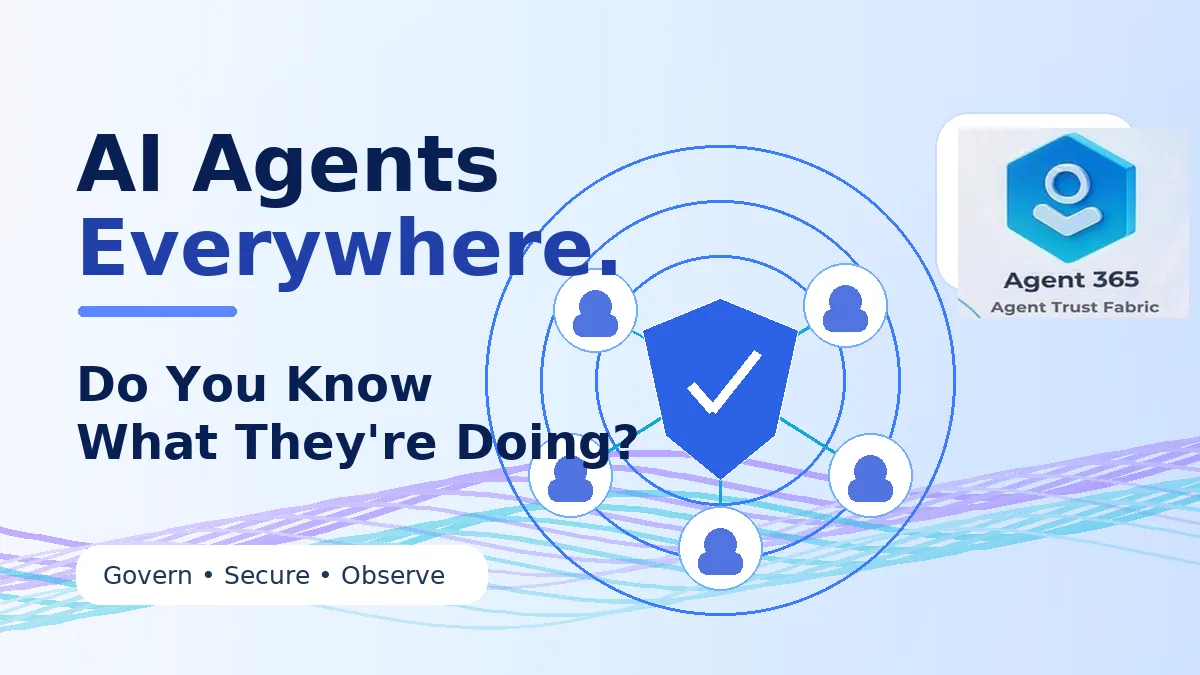
Your AI Agents Are Already Running. Do You Know What They're Doing?

Agent 365 reached GA in May 2026. Copilot Wave 3 ships agent capabilities to every E3 and E5 seat. Most organizations have no inventory of what’s running, no data access controls, and no audit trail. Here’s what the governance gap looks like — and what closing it requires.

August 1, 2026 Seepath Solutions

This Week's Advisory

August 1, 2026

Three signals your IT team can’t ignore

<div class="row g-3 my-3"> <div class="col-md-4"> <div class="card…

What the governance gap looks like in practice

Most IT teams discover ungoverned AI exposure one of two ways: a Purview…

Three gaps most organizations discover too late

Gap 1 — No agent inventory Most IT teams cannot answer “how many Copilot…

Seepath perspective

As a Microsoft Direct Bill CSP and AI Execution Partner, Seepath impleme…

Your AI Agents Are Already Running. Do You Know What They're Doing?

Three signals your IT team can’t ignore

Agent 365
Agent 365 GA — May 2026

Microsoft's native control plane for AI agents is live in every tenant. Most organizations haven't configured it — or inventoried what's already running.

Purview AI
Purview AI Hub now shipping

Microsoft built a dedicated AI data security layer because the exposure risk from unmanaged agents is real and growing with every seat that activates Copilot.

Wave 3
Agents bundled into Copilot Wave 3

Agent creation ships with standard E3 and E5 licenses — no separate procurement, no IT gate, no friction between an employee and a running autonomous agent.

The compounding risk is structural. Agents created by end users inherit the data access of the user who built them. There is no separate permissions layer by default. An agent built by a finance analyst can access everything that analyst can access — and act on their behalf, autonomously, without an IT ticket. In regulated environments, that's not an edge case. It's an audit finding waiting to happen.


What the governance gap looks like in practice

Most IT teams discover ungoverned AI exposure one of two ways: a Purview alert on an overshared SharePoint agent, or a compliance review that asks for an AI audit log that doesn’t exist. Neither is a comfortable starting point.

The governance gap isn’t about blocking AI use. It’s about knowing what’s running, scoping what it can touch, and being able to prove it to an auditor. The table below shows what each area looks like with and without a framework in place.

Area Without governance With AI governance framework
Agent visibility Unknown agents running on unknown data Full inventory via Agent 365 control plane
Data access Agents inherit unrestricted user permissions Scoped by sensitivity labels and Conditional Access
Compliance No audit trail for AI actions Purview AI Hub logs all agent activity
IT workload Reactive — incident response after exposure Proactive — policy enforcement before deployment
Regulatory posture Undocumented, unauditable Mapped to HIPAA, SOC 2, and EU AI Act controls

Three gaps most organizations discover too late

Gap 1 — No agent inventory Most IT teams cannot answer “how many Copilot agents are running in our tenant?” Agents are created in Copilot Studio, BizChat, and Teams with no centralized registry by default. Agent 365 solves this — but only after it’s configured and policies are applied, which requires an active setup step that most organizations haven’t taken.

Gap 2 — Data access is broader than intended Sensitivity labels and Microsoft Purview DSPM need to be deployed before agents are in wide use — not after. Retroactively scoping data access once agents are in production is significantly more complex, more disruptive, and more expensive than deploying governance at the start of rollout. The window to do this cleanly is now.

Gap 3 — Compliance frameworks are catching up fast HIPAA, SOC 2, and the EU AI Act are beginning to require documented controls for AI decision-making and data access. Organizations without an AI audit trail today will be retroactively rebuilding one under regulatory pressure — at a point when the trail has gaps that cannot be filled.


Seepath perspective

As a Microsoft Direct Bill CSP and AI Execution Partner, Seepath implements the full Microsoft AI governance stack — Agent 365, Purview AI Hub, Entra agent identity, and Defender AI Security Posture — as a structured, fixed-fee engagement. Governance is most effective when it's designed in from the beginning of your AI rollout, not retrofitted after an incident.

If your organization is actively deploying Copilot or has enabled agent capabilities, the right sequence is: audit what's running, scope what it can access, then build the ongoing operations layer.

Health Check

$3,995

1 week — fixed fee

Audit your AI agent estate, map data exposure, identify compliance gaps

Book a check →
Foundation Most popular

$9,995

2 weeks — fixed fee

Full implementation: Agent 365, Purview AI Hub, Entra identity, policy framework

Start foundation →
Managed Ops

From $2,995/mo

Ongoing — monthly

Ongoing governance, monitoring, policy updates, and quarterly AI risk reviews

Explore managed ops →

For teams running the Copilot in 30 trial, the governance foundation should be deployed in parallel — not after the trial ends. Agents built during the trial inherit permissions from day one.

"The organizations most at risk are not the ones that deployed too many agents. They're the ones that deployed without knowing what those agents were doing or what data they were touching."

Book an AI Governance Health Check →


Ready to Get Started?

Talk to a Seepath expert about your Azure, security, or AI strategy — no sales pressure.

Contact Us

Weekly Advisories

Get the latest Microsoft security, Azure, and AI updates delivered weekly.

Subscribe

Want Personalized Guidance?

Seepath has been a Microsoft Direct Bill CSP since 2014 — serving financial services and healthcare organizations.
with hands-on Azure, security, and AI implementation.

Free Azure Assessment Talk to an Expert